


Automotive Applications of Hardware-in-the-Loop (HIL) Simulation 电子书PDF下载_硬件在环仿真在汽车领域的应用
《Automotive Applications of Hardware-in-the-Loop (HIL) Simulation》是由福特汽车公司专家Adit Joshi编著、SAE International于2019年出版的技术文集,旨在为工程师和学生提供硬件在环仿真技术在汽车领域的系统入门指南。该书汇编了10篇2013-2018年间发表的SAE技术论文,涵盖传统汽车、电气化及自动驾驶三大应用方向。内容通过实际工程案例,重点探讨了SAE 2级自动驾驶的子系统故障处理与接管性能、线控制动系统开发、混动与纯电汽车的再生制动控制、驾驶性能开发、燃油指示器验证、自动车道保持及低速自动驾驶穿梭车的定位感知等热点工程问题。作为一本以案例驱动的实践性读物,该书适合希望快速理解HIL仿真在企业中如何解决实际问题的读者,但各章节由独立论文构成,连贯性相对较弱。
书籍定位
这本书是一本非常实用的技术入门读物,尤其适合希望系统了解HIL(硬件在环)仿真的学生和工程师。
作者Adit Joshi来自福特汽车公司,这本书由国际自动机工程师学会(SAE International) 于2019年出版,属于该领域的专业书籍,权威性不错。书中内容结合了作者在一线车企的实践经验,主要特点如下:
| 特性 | 说明 |
|---|---|
| 核心定位 | 面向HIL仿真的入门级资源,旨在帮助读者理解“什么是HIL仿真”、“它的优势是什么”以及“如何在企业中使用它”。 |
| 内容构成 | 汇编了10篇SAE在2013-2018年间发表的技术论文,覆盖传统汽车、电气化和自动驾驶应用。 |
| 技术深度 | 既有概念科普,也包含具体案例与数据,如故障处理、车道保持、制动系统开发等真实项目 |
这本书并非枯燥的理论教材,而是通过实际工程案例来讲解技术,可以重点关注以下内容:
- 聚焦前沿技术:涵盖SAE 2级自动驾驶的故障处理、线控制动系统开发、混动与纯电汽车的再生制动等热点话题。
- 解决工程痛点:探讨了如何通过仿真来提升汽车的驾驶性能、验证燃油指示器的准确性等实际开发中的具体问题。
由于其内容由独立论文汇编而成,各章节间的连贯性可能不如传统教科书。这本书更像是一个 “HIL实战案例库” ,能让你快速看到这项技术在实际中解决了哪些问题,更适合作为快速上手和拓宽眼界的“地图”。
网盘下载
Automotive Applications of Hardware-in-the-Loop (HIL) Simulation_202604092.zip - 蓝奏云网盘下载
全书一共两百多页,已经完整扫描了!请注意:本书仅供学习参考使用,请于24小时内删除,不要用于商业用途!
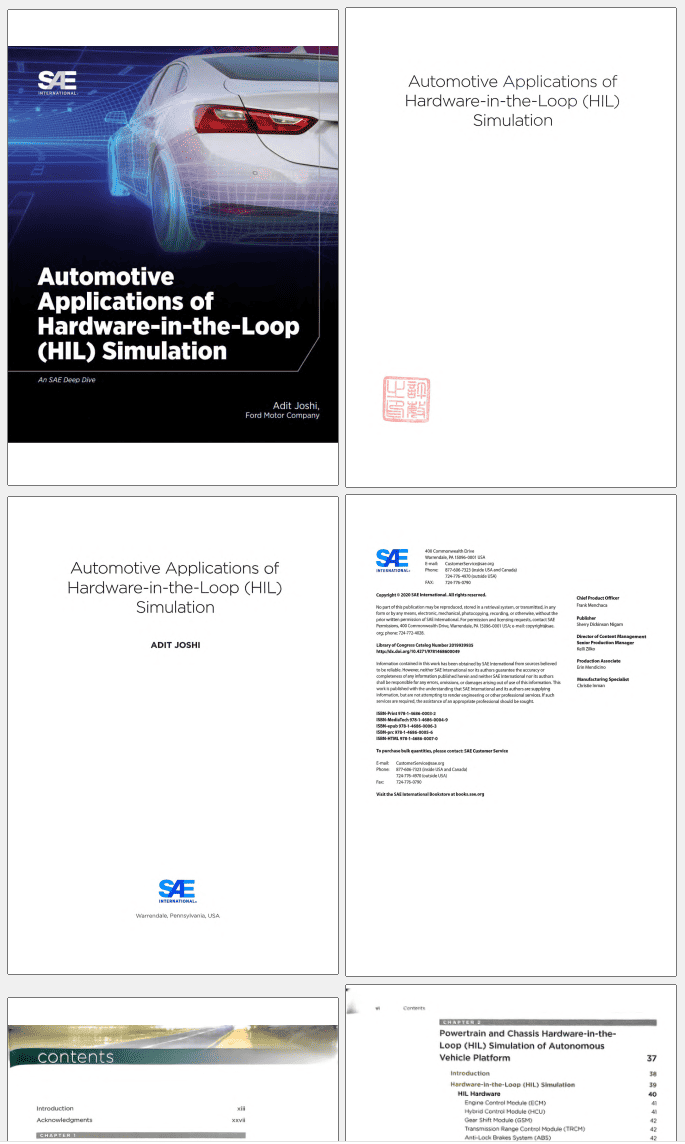
书本目录
CHAPTER 1 Hardware-in-the-Loop (HIL) Implementation and Validation of SAE Level 2 Autonomous Vehicle with Subsystem Fault Tolerant Fallback Performance for Takeover Scenarios ... 1
- Introduction ... 2
Hardware-in-the-Loop (HIL) Simulation ... 5
HIL Hardware ... 6
- Engine Control Module (ECM) ... 8
- Hybrid Control Module (HCU) ... 8
- Gear Shift Module (GSM) ... 8
- Transmission Range Control Module (TRCM) ... 8
- Gateway Module (GWM) ... 8
- Microautobox (MABX) ... 8
- HIL Modeling ... 8
- Automated Longitudinal Control ... 10
- Automated Lateral Control ... 12
- HIL SAE Level 2 Automation ... 16
Simulations and Test Results ... 20
- Automated Longitudinal Control Simulations & Test Results ... 22
- Automated Lateral Control Simulations & Test Results ... 24
- Subsystem Faults and Fallback Performance Simulation & Test Results ... 27
- Conclusions ... 33
- Contact Information ... 34
- Abbreviations ... 34
- References ... 34
CHAPTER 2 Powertrain and Chassis Hardware-in-the-Loop (HIL) Simulation of Autonomous Vehicle Platform ... 37
- Introduction ... 38
Hardware-in-the-Loop (HIL) Simulation ... 39
HIL Hardware ... 40
- Engine Control Module (ECM) ... 41
- Hybrid Control Module (HCU) ... 41
- Gear Shift Module (GSM) ... 42
- Transmission Range Control Module (TRCM) ... 42
- Anti-Lock Brakes System (ABS) ... 42
- Electronic Power Assisted Steering (EPAS) ... 42
- Gateway Module (GWM) ... 43
- Microautobox (MABX) ... 43
- Heads-Up Display (HUD) ... 43
- HIL Modeling ... 43
- HIL Implementation of Redundancies ... 45
Simulations and Test Results ... 48
- Powertrain Correlation Test Results ... 50
- Braking Correlation Test Results ... 52
- Steering Correlation Test Results ... 53
- Simulation Test Results over Disturbances ... 54
- Conclusions ... 57
- Contact Information ... 58
- Abbreviations ... 58
- References ... 59
CHAPTER 3 Real-Time Implementation and Validation for Automated Path Following Lateral Control Using Hardware-in-the-Loop (HIL) Simulation ... 61
- Introduction ... 62
Hardware-in-the-Loop (HIL) Simulation ... 63
- HIL Hardware ... 64
- HIL Modeling ... 65
- Path Following Lateral Controller ... 66
Simulations and Test Results ... 68
- Crosswinds Test Results and Sensitivity Analysis at Low-Speed Range ... 71
- Payload Position Test Results and Sensitivity Analysis at Low-Speed Range ... 73
- Payload Mass and Friction Test Results and Sensitivity Analysis at Low-Speed Range ... 75
- Acceleration/Deceleration Test Results and Sensitivity Analysis at Low-Speed Range ... 75
- Test Results and Sensitivity Analysis Over All Speed Ranges ... 75
- Discussion ... 81
- Conclusions ... 81
- Contact Information ... 82
- Abbreviations ... 82
- References ... 83
CHAPTER 4 Localization and Perception for Control and Decision Making of a Low Speed Autonomous Shuttle in a Campus Pilot Deployment ... 85
- Introduction ... 86
System Overview ... 87
- Hardware and Platform ... 87
- Vehicle Dynamics Model ... 89
Path Tracking Model ... 89
- A. Offline Path Generation ... 90
- B. Error Calculation ... 90
SLAM Algorithm ... 91
- A. Ground Noise Removal and Projection ... 92
- B. Map Generation and Scan Matching ... 93
Real World Experiments ... 95
- SLAM Evaluation ... 95
- Real Time Path Following Performance ... 98
HiL Studies ... 100
- Equipment and Setup ... 100
Test Scenario ... 101
- A. Decision Making ... 102
- HiL Simulation Results ... 102
- Summary/Conclusion ... 105
- Contact Information ... 106
- Acknowledgments ... 106
- Definitions/Abbreviations ... 106
- References ... 107
CHAPTER 5 Camera Based Automated Lane Keeping Application Complemented by GPS Localization Based Path Following ... 109
- Introduction ... 110
- Lateral Vehicle Model ... 111
- Lane Detection ... 112
- Path Generation ... 113
- Lateral Deviation Calculation ... 115
- Lateral Deviation from the Lane Line Detections ... 115
- Lateral Deviation Calculation from the Map and GPS Measurements ... 115
- Lateral Controller Design ... 116
- Hardware in the Loop Simulator ... 118
- Simulation Results ... 119
- Summary/Conclusions ... 120
- Contact Information ... 121
- Acknowledgments ... 121
- Definitions/Abbreviations ... 121
- References ... 122
CHAPTER 6 Use of HIL Simulation Applied to Verification of Automotive Fuel Level Indicator during Refueling Process ... 123
- Introduction ... 124
- Fuel Level Measurement System ... 124
Fuel Level Measurement System Tests ... 125
- In Vehicle Tests ... 126
- Bench Tests ... 127
- HIL Simulation ... 127
HiL Test Description ... 128
- The Unit under Test (UUT) ... 129
- Electronic Environment Simulation HiL ... 129
- Results ... 131
- Conclusion ... 131
- Contact Information ... 131
- Acknowledgments ... 132
- Abbreviations ... 132
- References ... 132
CHAPTER 7 Real-Time Hardware-in-the-Loop Simulation for Drivability Development ... 135
- Introduction ... 136
Drivability HIL Development Requirement ... 137
- Drivability Problem and HIL Approach ... 137
- Vehicle Model Requirement ... 139
- Hardware Requirement ... 139
Drivability CAE and HIL Simulation ... 140
Multi-Domain CAE Model Building ... 140
- Engine Plant CAE Model ... 140
- Transmission Driveline CAE Model ... 142
- Vehicle, Chassis and Tire MBD CAE Model ... 143
HIL Simulator and Controller Interfaces ... 144
- HIL Simulators ... 144
- HIL Sensor Actuator Signal Generation ... 146
HIL Test for Drivability Development ... 146
- Drivability HIL Simulation Process ... 146
- HIL Simulation Result ... 147
- Summary ... 149
- Contact Information ... 149
- Acknowledgments ... 150
- Definitions/Abbreviations ... 150
- References ... 150
CHAPTER 8 Regenerative Brake-by-Wire System Development and Hardware-in-Loop Test for Autonomous Electrified Vehicle ... 153
- Introduction ... 154
RBBWS System Layout ... 155
- System Outline ... 155
Working Modes ... 156
- Regenerative Braking Mode ... 156
- Active Braking Mode ... 157
- ABS/ESP Mode ... 157
- Fail-Safe Mode ... 157
System Modeling and Control Strategy Design ... 158
System Modeling ... 158
- Vehicle Body Dynamics ... 158
Tire ... 159
- Rotational Dynamics Modeling ... 159
- Tire-Ground Force Modeling ... 159
- Electric Motor Modeling ... 160
- Battery Modeling ... 160
- Hydraulic System ... 160
- Regenerative Braking Control Algorithm ... 161
Simulation ... 162
- Simulation Scenario Set-up ... 162
Simulation Results ... 163
- Typical Braking ... 163
- Active Braking ... 163
Hardware-in-Loop Bench Test ... 165
- Typical Braking ... 166
- Active Braking ... 167
- Conclusions ... 168
- Contact Information ... 169
- Acknowledgments ... 169
- Definitions/Abbreviations ... 169
- References ... 170
CHAPTER 9 Testing and Validation of a Belted Alternator System for a Post-Transmission Parallel PHEV for the EcoCAR 3 Competition ... 171
Introduction ... 172
- Team Vehicle Architecture ... 172
- BAS System ... 173
- Overview of Experiments Conducted ... 176
Test Bench Setup ... 176
- Inverter Calibration ... 176
- BAS Powered No Load Test Setup ... 179
- BAS Powered Test Setup under Load ... 179
- BAS—Engine Coupling ... 181
System Modeling ... 182
- System Modeling Environment ... 182
- Belted Alternator Starter Model ... 182
- Belt Coupler Model ... 184
- Engine Model ... 184
- Soft ECUs ... 185
- Model Limitations ... 186
System Control Strategies ... 186
- Steady State Torque Mapping ... 186
- Engine Start Up ... 187
Experimental Design ... 188
- Continuous Region of Operation ... 189
- Simulated Engine Start ... 190
- Higher Torque Region of Operation ... 190
Overview and Impact of Key Results ... 192
- Comparison of Team Defined Control Strategies ... 192
- Comparison of Simulation and Bench Test Results ... 193
- Conclusions ... 197
- Contact Information ... 198
- Acknowledgements ... 198
- References ... 199
CHAPTER 10 Regenerative Braking Control Enhancement for the Power Split Hybrid Architecture with the Utilization of Hardware-in-the-Loop Simulations ... 201
- Introduction ... 202
- Hil Model Validation ... 203
- Enhanced Regen Control for Booster Delay Compensation ... 206
- Enhanced Regen Control During ABS Activation ... 210
- Summary/Conclusions ... 213
- References ... 213
About the Author ... 215
本文章是52txr原创文章,未经许可,禁止转载,禁止任何AI爬虫使用本网站内容。开源小栈是陶小桃Blog纯技术/知识的分身网站,欢迎每一位访客朋友。

暂无评论数据